The Milk Rebellion in Falmouth, KY: A Turning Point in Local Dairy
 Chris Collins - Whisper One
Posted On November 9, 2025
Chris Collins - Whisper One
Posted On November 9, 2025
The Lead Up: Mounting Pressure in Dairy
Falmouth’s Milk Dump Protest and the Decline of Kentucky’s Dairy Era
By the early 1960s, dairy farmers across Kentucky were feeling squeezed. Costs for feed, fuel, labor, and equipment kept rising, while the price they received for milk stagnated or in some cases dropped.
In Kentucky, for example, small dairy operations were being pushed out as consolidation took hold, and the number of dairy farms was declining at a rate of about 8 percent per year
(The Dairy Site).
In rural counties like Pendleton, farms were smaller, production less efficient, and the infrastructure for dairy such as trucking, processing, and markets was less robust. These structural disadvantages meant that when market shocks hit, local dairies were more vulnerable.
1967: A Year of Desperation and Defiance
By early 1967, a growing sense of desperation had taken root. The national organization National Farmers Organization (NFO) had already announced a milk holding action on March 15, 1967, encouraging farmers to withhold or dump milk to force processors and market handlers to negotiate better terms
(Iowa State Digital Collections).
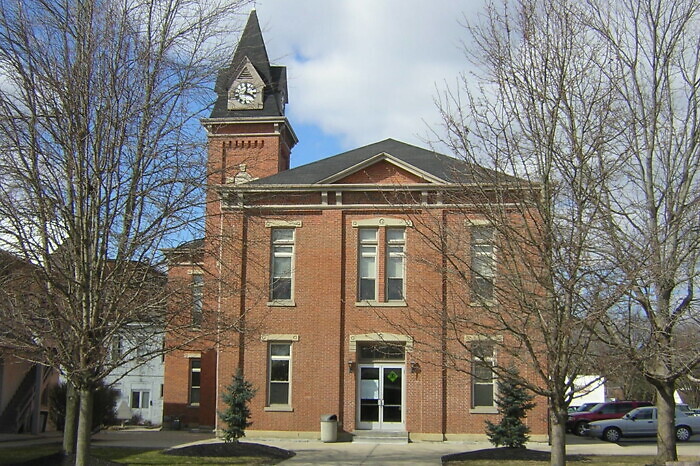
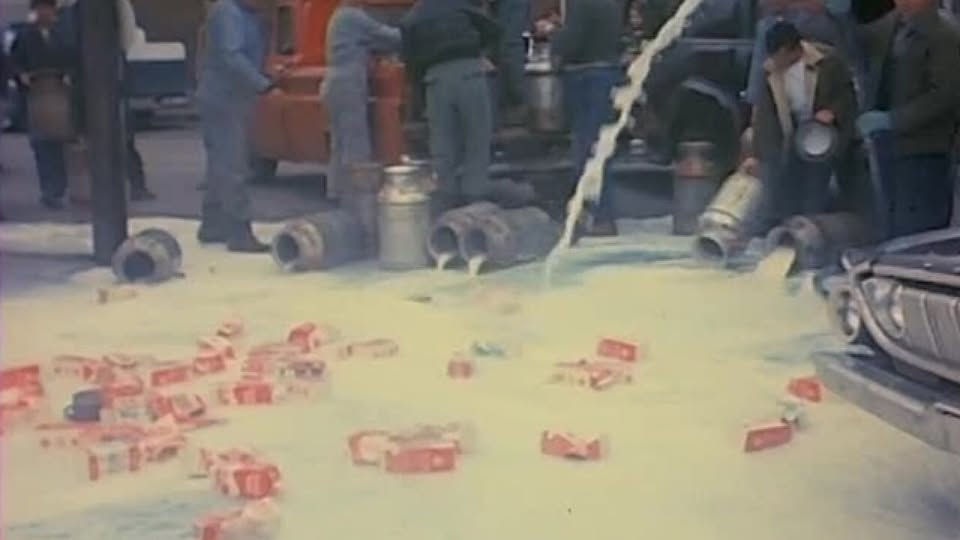
In March 1967, dairy farmers in and around Falmouth joined what had become a larger national movement of dairy protest. According to a retrospective by the local Cincinnati based station, the protest in Falmouth saw gallons of milk poured into the streets around the courthouse as a show of force and frustration
(WCPO 9 Cincinnati).
“This is the only bargaining power we have, our product. We have tried to bargain for a price, begging for a price… and we figured we have to take a more drastic action.”
(WCPO 9 Cincinnati)
Details specific to Falmouth indicate that at least 3,600 gallons (31,000 pounds) of milk were dumped in protest of low prices and unsustainable farming conditions.
The message was clear. Local dairies could no longer survive under prevailing conditions, and this act was a public challenge to the status quo.
After the Protest: A Steep Decline
Following the protest, dairy in Kentucky entered a period of marked decline. Between 1993 and 2013, Kentucky lost roughly 40 percent of its dairy cows (about 48,000 animals), even as production per cow improved slightly
(Farm Flavor).
By 2018, it was reported that Kentucky had only 562 permitted dairy farms remaining, a steep drop from earlier decades
(Courier Journal).
The combination of economic pressure, industry consolidation, and regional structural disadvantages meant that many small dairy farms in counties like Pendleton simply could not keep up.
Every farm that went out of business removed not only milk production, but supporting economic networks such as truckers, feed suppliers, laborers, and processors.
A Moment That Meant More Than Milk
For Falmouth, the 1967 dumping event stands out as a public moment of community action, but behind it lies a quieter, more persistent story of decline.
Where once family dairies might have been a stable backbone of the local farm economy, by the late 20th century many had exited or shifted to other agricultural enterprises.
The dairy industry’s contraction meant fewer local jobs, fewer processing opportunities, and less ripple economic impact in rural service industries.
That act of dumping milk in Falmouth’s streets embodied the loss of confidence in the industry’s future. It was a signal that business as usual was no longer viable.
And indeed, the years since have borne that out.
More Than Protest, A Public Inflection Point
The milk rebellion in Falmouth is more than a curious local protest. It is an inflection point. It was the moment a viable local industry declared its crisis publicly.
The years leading up to the protest show a buildup of pressure and structural disadvantage. The protest itself becomes symbolic. And the aftermath demonstrates the inevitable decline of an industry once central to rural Kentucky’s agricultural economy.
For Falmouth, remembering that moment and its causes provides a clearer understanding of how local economies evolve, struggle, and transform when the market no longer works for the many.
Whisper One Out
Trending Now