Fragmented Funding Can Lead to Fragmented Service Outcomes
 Chris Collins - Whisper One
Posted On February 1, 2026
Chris Collins - Whisper One
Posted On February 1, 2026
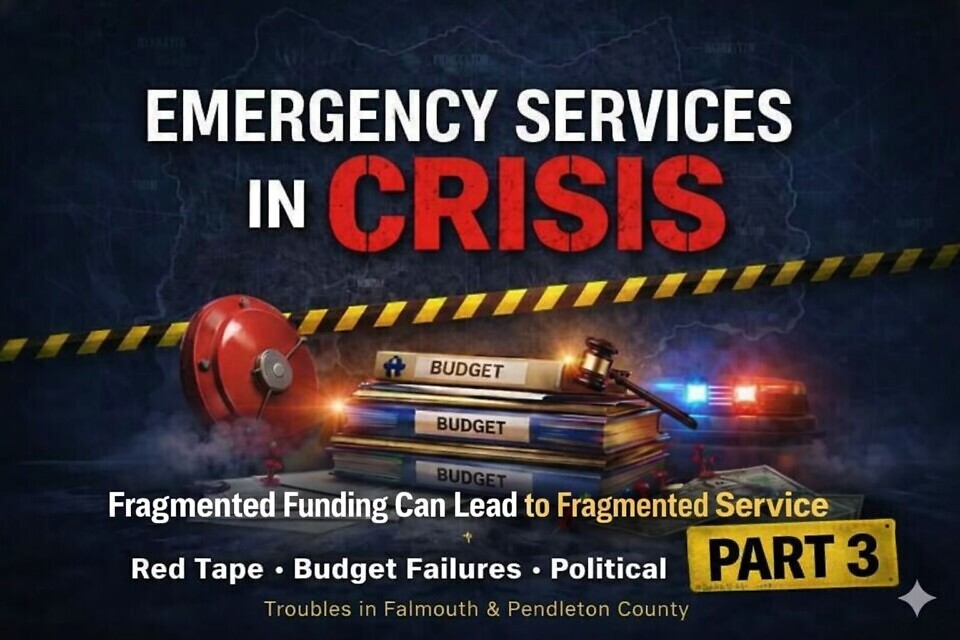
If you ever wondered why your ambulance might show up late, your fire districts are fighting over who covers what and how, or why police budgets can climb without 24-hour coverage, we do also.
We’re not just dealing with high taxes. We’re dealing with fragmented taxes, a system where different agencies all levy their own rates, issue their own budgets, and try to fund their piece of the pie while pretending they’re not in the same kitchen. And somehow, it all shows up on one bill like it’s simple. Who’s in charge of what, who covers what, and what coverage can exist with fragmentation is just another side of this. There isn’t a “the buck stops here” in any of this. The system is designed to pass the buck. Sure, all of this answers to audits, and those audits always skate by, but you’re still left with the important questions: Will I get my life saving service on time, or will it fail me or my loved one? Will I be able to rely on my emergency being handled in a timely manner?
You start asking these questions and people get uncomfortable. They get territorial. Some outright deny there are issues, and others claim they are all lies. The people that ask those questions never get satisfactory answers and often are left wanting and waiting. These systems are designed to fail without adequate funding. They are also engineered to have the illusion of a process with no clear owner of the problems created by it.
Back to the Tax: One Bill, Many Masters
Pendleton County’s tax bill looks unified. In reality, it’s a patchwork quilt sewn by separate boards, districts, city halls, and the fiscal court. You’re paying:
-
County general taxes
-
Tangible property taxes
-
Fire district levies (multiple)
-
Ambulance district rates
-
Library district taxes
-
School taxes
-
City property taxes (if you live in Falmouth or Butler)
-
Occupational taxes
-
Franchise and motor vehicle taxes
-
Insurance premium taxes (city only)
And not all of them report to the fiscal court. Some don’t even coordinate with each other.
So when services lag, don’t just blame “the county.” Ask which entity, which budget, and what agreement or lack thereof is driving the delay. Convoluted is what comes to mind if you ask me. If it wasn’t designed as the perfect storm of zero accountability and zero recourse, I don’t know what is.
Fire and Ambulance: Case in Point
The county used to pay Falmouth for fire protection. That’s ending. The county is building its own fire department, and someday it will be finished. Meanwhile, what happens to Falmouth Fire Department? What happens to Northern Pendleton Fire Department? Who is in charge of the results and outcomes? Where can citizens get recourse? Will response times get better now? It’s a compartmentalized nightmare to unravel. Why is our ambulance services funded so poorly?
Some Other Questions That Remain
Who’s coordinating emergency services across district lines?
Who’s making sure Fire and EMS aren’t duplicating costs or leaving gaps?
Is there any coordination, or are these just separate entities we may or may not be able to rely on?
NPFD (Northern Pendleton Fire District) taxes residents at $2 per thousand, double what the rest of the county pays, because they also have to fund ambulance services. That’s not “better funding,” that’s a community forced to double up just to survive.
Let’s not forget: donations were needed to buy life-saving CPR equipment for our ambulance service. If that doesn’t scream “systemic funding failure,” what does?
Road Budgets: Hidden Drain
Your cell phone fees and landline taxes are supposed to help pay for dispatch. After the general fund had to prop up the cost, they contracted out of county, using KSP dispatch. This was a largely unpopular, fiscally sound decision. Was it needed though? Could something else have made it better or more efficient?
When your emergency services need to rely on general funds to help bail them out, that is money not going to roads, salaries, or equipment, unless they pull even more from general funds, which they did. For the past two years, the road department’s upgrades have depended on extra general fund help. So if you’re wondering why potholes don’t get fixed or why some roads don’t get repaired this is one reason.
The Real Problem: No One Sees the Whole Board
Each district sees its own need. Each board thinks it’s doing its job. But no one is stepping back and asking what the people actually experience.
What residents see is:
-
Services delayed
-
Equipment underfunded
-
County officials bickering over land
-
Volunteer fire departments scraping to survive
-
Cities using “economic development” funds to patch together police and parks projects
But what they don’t see is why.
Because the structure is built to confuse you.
So What Do We Do?
First, we ask and echo questions about this fragmented ecosystem. These questions help build a conversation.
Second, we can start talking about it. And from those conversations, people are informed about how it works, who to inquire and question about things, and more importantly, how this fragmented system can be replaced by something better. Out loud. With maps, charts, and real language, not bureaucratic spin.
Third, we demand unified public responses, who gets what, who spends what, and who’s responsible.
And fourth, we push back against the idea that this can’t be simplified.
Because fragmented funding and fragmented management creates a fractured reality, where half the budget is hidden behind abbreviations and the other half is pretending it’s someone else’s problem.
Let’s stop letting a jumbled system convince us that accountability is impossible. It’s not.
It just requires paying attention.
And around here, we’re finally starting to.
Listen folks, I don’t have all the answers. One person cannot. I am wrong sometimes, I admit it when I am shown to be. Just like that, the other side is, no matter how much research I do, no matter how many questions I ask, much of this is a maze.
It’s designed that way, a product of a system built to leave uncertainty, so you can’t pay attention to how messed up it all is. Officials whether fiscal, city, boards often they also don’t have all the answers. They are held hostage by the system and may not always be using this system to their advantage. I am sure that happens but too often they can say only this is the way it has been, is and will be. It’s ironic you have to wonder why so many won’t stop, step back and reflect on the fact a system built to be fragmented will nearly always fail.
Here at Whisper Networks LLC, we will continue to research, question, poll, inspire comment, and try to find the answers to every inquiry. Feel free to send us messages, make your comments, and join the discussion. It is only through these discussions that true change can be inspired.
Whisper One Out
Trending Now