Before Falmouth Was Falmouth, War Came Through Here
 Chris Collins - Whisper One
Posted On May 31, 2026
Chris Collins - Whisper One
Posted On May 31, 2026
Most of us know Falmouth as a river town. The courthouse, Main Street, the flood stories, the old family names, the churches, the bridge, the places people remember because somebody older than them pointed and said what used to be there. But there is an older layer under that. Before Falmouth was laid out, before it had a name, this spot at the forks of the Licking was used as a stopping point in one of the most serious Revolutionary War incursions into Kentucky.
On May 25, 1780, Captain Henry Bird moved south from Detroit under British authority. With him were British, Canadian, and Native allied forces, along with artillery. They worked their way through the river routes, crossed Lake Erie, moved through the Maumee and Great Miami route, reached the Ohio, and then pushed up the Licking River into Kentucky. Artillery had joined the frontier war in a way these stations were not built to handle. (Source: Encyclopedia.com, Kentucky Raid of Bird)
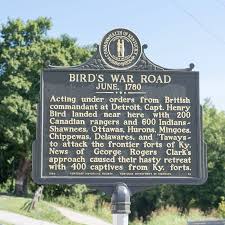
The historical marker at Shelby and Main Street in Falmouth says:
“Acting under orders from the British commandant at Detroit, Col. Henry Bird landed near here with 200 Canadian rangers and 600 Indians-Shawnees, Ottawas, Hurons, Chippewas, Delawares, Mingoes and ‘Taways-to attack the frontier forts of Kentucky. News of George Rogers Clark’s approach caused their hasty retreat with 400 captives from Kentucky forts.”
When they came to this area, it was not some small raid. This was not a few men slipping through the woods. This was an organized military expedition.
When the boats could not go any farther, they stopped at the forks of the Licking. That is where Falmouth sits now. (Source: Kentucky Historical Society, Bird’s War Road, June 1780)
The water was too shallow to keep moving the boats and artillery, so the force had to unload. They stored what needed to be stored. They gathered the men. Then they cut a road through the timber toward the Kentucky stations.
That road became known as Bird’s War Road. John Filson named the route “Bird’s War Road” in his 1784 book, The Discovery, Settlement, and Present State of Kentucke. (Source: Kentucky Legislative Research Commission, Pendleton County: Byrd’s War Road)
Now that is the kind of history we should actually stop and think about.
Because this town did not begin with a council table or a city seal. It did not begin with some clean little paragraph in a county history book. It began even before John Waller laid out Falmouth. In those early roots, the ground where Falmouth would later stand was a military landing point in the Revolutionary War.
The reason was simple. Geography. Once the boats could go no further, Bird’s land route began here.
After staging, they marched toward Ruddell’s Station.
Ruddell’s was one of those frontier stations that families depended on for survival. It was not a fort in the way people imagine stone walls and towers. It was a log station in dangerous country, built because settlers needed somewhere to gather when trouble came. Trouble came when Bird’s advance forces surrounded the station.
A log wall might stop bullets. It was not built to stand against artillery. Ruddell’s Station was in a position that no frontier family would want to face. Hold out and risk being destroyed, or surrender and trust that surrender terms would mean something. They surrendered. (Source: American Battlefield Trust, Ruddell’s Station Battle Facts and Summary)
And that is where the story gets ugly, because history usually does.
The surrender did not unfold cleanly. Accounts describe chaos after the gates opened. Families were separated. Property was taken. Some people were killed. Many were taken captive and marched north. Bird may have had military terms in mind, but once the station fell, control was not as simple as writing down conditions and expecting everyone to obey them.
That is one of the hard truths of this story.
Settlers surrendered because they had no better option. Once all the pressures of an overwhelming force came together, nobody inside that station was really in control of what happened next.
Simon Kenton arrived at Ruddell’s Station hours after Bird’s departure and reported a number of people lying killed and scalped. Bird’s own report also shows how quickly the surrender fell apart, saying some Native allied forces seized prisoners contrary to agreement and threw everything into disorder. (Source: Maude Ward Lafferty, Destruction of Ruddle’s and Martin’s Fort)
After Ruddell’s Station, Bird moved on to Martin’s Station.
Martin’s surrendered without firing a shot. (Source: American Battlefield Trust, Martin’s Station Battle Facts and Summary)
That tells you how much fear had already spread. Once word got around to other stations, the whole calculation changed. These settlements were not prepared for that kind of war.
Bird’s Native allies wanted to keep going. Bryan’s Station and Lexington were possible next targets. But the expedition was already carrying prisoners, supplies were strained, livestock had been killed, and the whole force was becoming harder to manage. (Source: Encyclopedia.com, Kentucky Raid of Bird)
So Bird turned back.
One surviving captive account gives us a glimpse of what that return north looked like.
Captain Dunkin says he was taken on June 26, 1780, from Licking Creek by Captain Henry Bird and allied Native forces. He describes the prisoners marching down the Licking about 50 miles to the Ohio, then being taken north through the Miami route, Lake Erie, Detroit, Niagara, Lake Ontario, and beyond. The Kentucky National Guard history preserves this account and gives the route in his own words. (Source: Kentucky National Guard History, Destruction of Ruddle’s and Martin’s Fort)
And that brings the story back to Falmouth.
The same place where they landed became part of the return route. The force came back to the forks and gathered what had been left behind. Then they loaded their boats and moved back down the Licking with captives and consequences behind them.
Whether there were already scattered settlers near the future town site at that exact moment is harder to pin down. What is clear is that the forks themselves mattered before Falmouth was formally established. This area was a strategic place in Bird’s invasion of Kentucky in 1780.
That matters.
The old Pendleton County histories say Bird landed in 1779 near the place where Falmouth later grew. The historical marker, the accounts of Ruddell’s and Martin’s stations, and the broader timeline of Bird’s invasion all line up with 1780. (Source: Kentucky Historical Society, Bird’s War Road, June 1780)
The exact prisoner count varies by source. The historical marker in Falmouth says Bird retreated with 400 captives from Kentucky forts. The American Battlefield Trust also says Bird returned to Detroit with about 400 prisoners, while Encyclopedia.com gives the number as 350. Either way, hundreds were taken north, and the fall of Ruddell’s and Martin’s stations caused panic across the frontier. (Sources: Kentucky Historical Society, Bird’s War Road, June 1780; American Battlefield Trust, Martin’s Station Battle Facts and Summary; Encyclopedia.com, Kentucky Raid of Bird)
The forks of the Licking were not just scenery. They were a stopping point, a turning point, and in 1780, a war route. Before Falmouth became Falmouth, men came through here with artillery, captives, fear, and purpose. That does not make this town famous. It makes it older, deeper, and a little harder to dismiss.
Whisper One Out
Trending Now