Falmouth Has Always Decided Its Future in Town Halls
 Chris Collins - Whisper One
Posted On March 1, 2026
Chris Collins - Whisper One
Posted On March 1, 2026
Town halls are not new to Falmouth.
They are not a political invention of 2026, and they are not a novelty, a courtesy, or a box to check. They are how this town has made every major decision since the first settlers put a courthouse on the rise above the river in the 1790s, back when Pendleton County government was literally formed in a public assembly where citizens chose officers, debated taxes, and argued over the cost of the first jail and courthouse (Pendleton County Court Order Books, 1798).
Falmouth has always been a place that shows up when the stakes are real.
When the new courthouse was proposed in 1848, it wasn’t a quiet affair. The meeting records describe protests, accusations of favoritism, and taxpayer outrage over construction overruns (Pendleton County Minutes, 1848). The entire project teetered because citizens refused to be silent. The courthouse that stands today exists because people stood in a room and said what needed saying.
In 1862, as Confederate cavalry moved through northern Kentucky, Falmouth residents crowded into emergency wartime meetings, debating militia powers and Home Guard actions as gunfire literally echoed in the county (KY Adjutant General Reports, 1862). The town’s safety came down to whether citizens remained passive or spoke their fears out loud.
The same pattern repeated in the 1870s when the railroad came. The route cut through properties, businesses protested, farmers objected, and the county held heated public assemblies where the fight over land, money, and the future of commerce filled the room (L&N Railroad Proceedings, 1873–1875). The final route was not chosen by bureaucrats. It was forged in a shouting match where the town refused to be ignored.
When Prohibition hit, Falmouth filled its town meetings again, pastors, officers, bootleggers, and regular families arguing over enforcement, nighttime ordinances, raids, and liquor transport (Falmouth Outlook Archives, 1920s–1930s). These debates shaped law, shaped policing, and shaped the town’s identity long before modern politics ever did.
And when disaster came, Falmouth did what Falmouth always does: it gathered.
After the 1964 flood swallowed downtown, the town met with federal engineers and argued fiercely over what should be rebuilt and what should not (USACE Flood Records, 1964). The same happened after the 1968 F4 tornado, when emergency housing, school safety, and zoning changes were debated late into the night (State Emergency Management Minutes, 1968).
And then came 1997.
The most documented cycle of town halls in modern local history.
FEMA meetings overflowed with residents demanding fairness in buyouts, questioning appraisals, begging for help, or refusing relocation outright. There were shouting matches, walkouts, tears, and hard truths, but every meaningful decision that rebuilt this town came from those rooms (FEMA Community Mitigation Meeting Notes, 1997).
If Falmouth has a story, it is this:
Silence has never saved this town. Speaking up has — every time.
Which brings us to now.
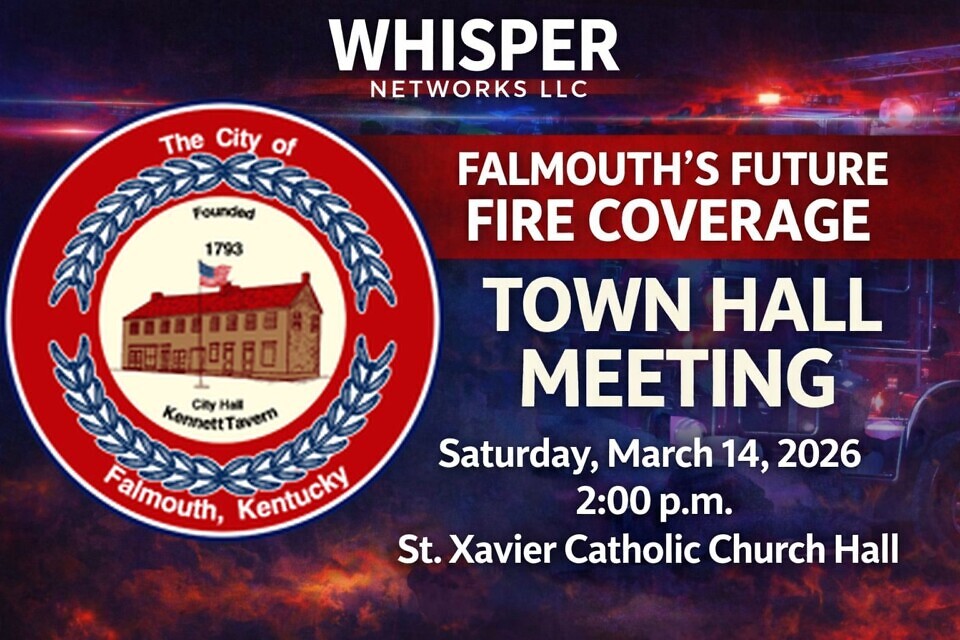
The City of Falmouth has called a Special Town Hall for:
📅 Saturday, March 14, 2026
⏰ 2:00 p.m.
📍 St. Xavier Catholic Church Hall
The topic:
The future of fire service for the City of Falmouth.
This is not a casual meeting.
This is not a symbolic gesture.
It is a fork in the road as real as the courthouse fight of 1848, the railroad conflicts of the 1870s, the flood hearings of 1964 and 1997, and the emergency gatherings during the Civil War.
Every era of Falmouth has had its defining choice, the moment ordinary residents stepped into a room, put their voices on record, and altered the direction of the town. This meeting is one of those moments.
Because fire protection isn’t just a service.
It’s survival.
It’s safety.
It’s response times.
It’s whether the next disaster finds us prepared or exposed.
And like every generation before us, the only thing that guarantees the right outcome is showing up.
This is another one of those rooms where Falmouth decides its future.
And the town has never been wrong when it fills the room and speaks.
Whisper One Out
Trending Now