
Falmouth’s Long History of Pipes, Floods, and What We Drink
 Chris Collins - Whisper One
Posted On December 7, 2025
Chris Collins - Whisper One
Posted On December 7, 2025
Falmouth Kentucky: A Water History Written in Flood and Failure
Rivers Gave Life and Risk
Falmouth is a small town at the meeting point of the Main Fork and South Fork of the Licking River. That geography brought life. It gave transport, trade, land, and growth. But it also brought risk.
Floods, shifting water systems, aging infrastructure, and changing regulations have turned water into a story of both survival and failure.
A Town Built on Low Land
Falmouth’s location offered clear advantages. Fertile land, river transport, and access to water. But it also meant sitting on low flood plains.
That was not neutral.
According to the US Geological Survey, the 17 mile reach of the Licking River near Falmouth has been mapped for flood stage risk. The data shows how many historic and future floods could overwhelm the area.
(US Geological Survey Publications)
The Flood of 1997: A Defining Catastrophe
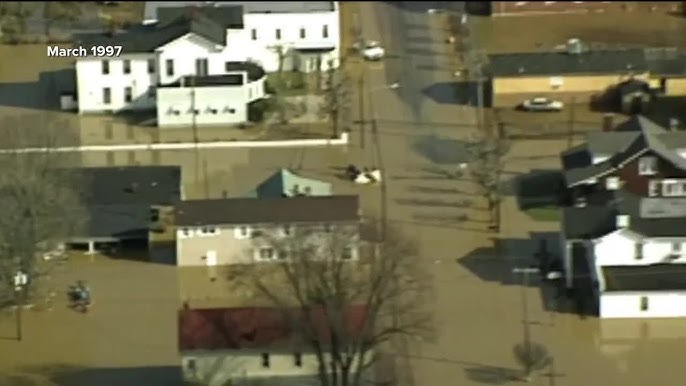
On March first and second of 1997, heavy rain across the Ohio River Valley triggered one of the most devastating floods in Kentucky history.
-
The Licking River crested at 52 feet, nearly 24 feet above flood stage
-
80 percent of Falmouth was under water
-
Homes and businesses were destroyed
-
Five local residents died
-
Downtown was decimated
(WCPO Nine, FEMA, WOSU, NKY Views)
This became a pivot point. The community began buyouts, mapping, and better emergency protocols. But water, as both friend and hazard, has remained a force in Falmouth ever since.
Water Supply: A Separate but Serious Crisis
Rivers are not drinking water. Towns like Falmouth depend on treated public systems, aging pipes, and groundwater wells.
The Falmouth Water Department and Pendleton County Water District Number One serve most residents.
Between 2018 and 2023, the Environmental Working Group flagged multiple water quality issues, including
-
Haloacetic acids at 33.7 parts per billion
-
Nitrate levels at 0.295 parts per million
(EWG Tap Water Database)
These levels pass federal minimums, but far exceed what EWG considers health safe.
Beneath the Surface: Risk in the Ground
The Kentucky Geological Survey shows Pendleton County sits over irregular freshwater and saline boundaries. Some groundwater zones, especially when drilled too deep, risk contamination or salt intrusion.
This means many rural wells, springs, and aquifers may be vulnerable. The older the system, the greater the risk.
The Infrastructure Problem
Putting it all together
-
Flood risk is constant
-
Pipes are aging
-
Treatment systems struggle
-
Rural wells are unprotected
-
Water reports show long term risks
-
Hydrants have failed
-
Water pressure has dropped
-
Critical infrastructure was left behind
The pattern is clear. Fixes came after disaster. Rarely before.
The Green Sink: A Bandaid Not a Solution
Now the city is promoting a project called the Green Sink. It is pitched as a solution to runoff and flooding. It sounds good. A flood basin. A detention project. Something that can handle rain.
But let us be clear.
Green sinks handle gallons per minute.
Floods are measured in cubic feet per second.
In 1997, the corrected river flow rate was estimated between 250 thousand and 280 thousand cubic feet per second.
That is between 112 and 125 million gallons per minute.
Your Green Sink might handle five thousand gallons a minute. The river brought more than one hundred million.
You cannot sponge that.
You cannot detain that.
You cannot landscape your way out of a flood that climbs 24 feet.
Look at the Flood Path
The water came from the south and swept across the Main and South Fork confluence. It surged through Main Street, Shelby, Maple, and Court.
It did not wait for grant projects or detention ponds.
It followed physics.
It followed gravity.
And it destroyed almost everything in its way.
The Real Problem Is Not the Water
The problem is not the creek.
It is not the rainfall.
It is the system.
A town that allowed its pipes to rot. That let its hydrants fail. That left water infrastructure to decay for decades. And now wants a shiny new project to distract from the truth.
This is political cover.
Not a real solution.
You Cannot Build Trust Without Honesty
You do not need another flashy name.
You need working pipes.
You need real maintenance.
You need honesty.
Because trust does not come from branding.
It comes from acknowledging the damage.
Think Before You Vote
You want real change in Pendleton County?
Start by asking who let this happen
Ask who is trying to paint over it with buzzwords
Ask who is still pretending that a detention pond can fight a river
This is not about party lines
It is about leadership
It is about memory
And it is about consequences
You do not need a flood basin if you do not build in a basin
You do not need another cover story
You need truth
Think about that when you vote in 2026
Whisper One Out
Trending Now
Before Falmouth Was Falmouth, War Came Through Here