The Rise of Dairy Farming in Pendleton County
 Chris Collins - Whisper One
Posted On October 26, 2025
Chris Collins - Whisper One
Posted On October 26, 2025
0
Pendleton County’s hills, once considered more burden than blessing, weren’t always the pastoral gem they are today. By the late 1800s, the land was chewed through by decades of row cropping, mostly tobacco, corn, and wheat. The soil was tired, and the farms were fading. But what couldn’t grow a cornfield turned out to be damn near perfect for clover, cows, and cream.
Around the turn of the 20th century, farmers started turning those worn-out slopes into pasture. Sweet clover, once considered a weed, was seeded across tens of thousands of acres. By 1916, more than 50,000 acres of clover and 60,000 acres of mixed grasses were in production across Pendleton County (Country Gentleman, 1916, via NKY Tribune). That wasn’t an accident, farmers saw what was happening to the soil and knew if they didn’t pivot, they’d be finished.
Better pasture meant healthier cattle, and with them came something new to the region’s economy: a full-blown dairy industry.
“Then sweet clover was planted, the bees came and founded a great honey-making colony, dairying developed, and the county and county seat were reinstated on the map.”
(Northern Kentucky Views)
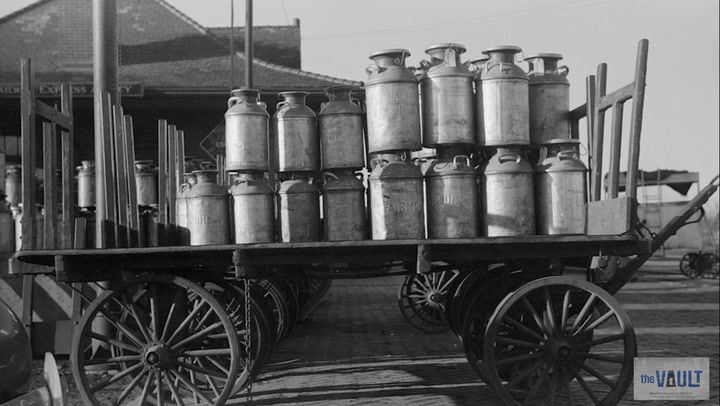
By the 1910s, milk and cream weren’t just for the table anymore. They were a product. A route. A paycheck. Farmers were loading up 10-gallon cans and sending them off to local creameries, three of which were reported in the county by that time (Falmouth Outlook archives, 1917). The surplus was shipped directly to Cincinnati, often over rail, sometimes over backroads before sunrise, the cans cooled by ice or cloth sacks soaked in well water.
The infrastructure adapted right along with it. Old tobacco barns were reworked for cows. Springhouses were replaced with ice tanks. Roads improved. And by 1920, Pendleton County was pulling in an estimated $600,000 annually from livestock, milk, and cream (USDA Bureau of Markets, 1920).
“Pendleton County was once dismissed as nothing but hills and washed-out farmland but that terrain turned out to be perfect for cows, clover, and cream.”
(NKY Tribune, quoting 1916)
In the background, The Falmouth Outlook was full of ads offering “cream pickup Tuesday and Friday” and urging farmers to “separate early, ship clean, get cash.” Farmers were buying separators, building stanchions, and working their way into a market economy from what used to be survival work.
Even now, you can still see what was left behind. Barns with low ceilings and looped iron rings. Long troughs poured in concrete. Narrow dirt lanes that once had wagon wheels rattling through them at 5AM with milk cans packed in blocks of ice. A 1938 WPA map even shows eleven marked milk collection points stretching along old routes between Butler, Morgan, and Falmouth (WPA Rural Inventory Maps, 1938).
Before refrigeration trucks and stainless-steel tanks, milk was a race against time. It had to be cold. It had to be clean. And it had to move.
“We’d haul cream into Falmouth before sun-up, had canvas bags and cut ice from the river when it was thick enough to store,”
(Pendleton County Historical Society, oral history interview, 1982)
This wasn’t big-industry farming. It was rural, local, and family-run. But it worked. The money it brought in kept general stores alive, paid off mortgages, and kept younger generations on the land. For the first time in decades, these hills had an answer.
The Fade and What’s Left
Fast forward to now and the 2022 USDA ag census for Pendleton County lists “milk from cows” as simply (D), meaning the number of dairy farms is so low they don’t even report it publicly. That chapter has ended. But it was never small.
Pendleton County moved from worn-out row crops to thriving pasture. It found a niche, not in size, but in resilience. Falmouth and the surrounding hills became part of a broader system, feeding cities and lifting farms.
The dairy routes are mostly gone. But the bones are still here, in the barns, the backroads, and the way people still talk about that time when milk saved the county.
This isn’t the only story about Milk. In the past we alluded to the Milk Rebellion. Next weeks article will be about the years before that, leading up to and beyond that time period.
Whisper One Out
Trending Now
Before Falmouth Was Falmouth, War Came Through Here
May 31, 2026

A Special Announcement From Whisper Networks LLC
May 30, 2026